SUPPORT OUR WORK: DONATE HERE!
After having searched the universe and coming to the belief in one G-d, Prophet Ibrahim declares: “My Lord extends everything as knowledge.”(6:80) These words may also be translated “My Lord created everything to broadcast knowledge.”
What is striking about this statement is its placement. It follows Abraham’s reflective searching of the heavens—the stars, the moon, the sun—and therefore seems to represent the conclusion of that entire experience. In other words, it appears to be the insight Abraham was guided to arrive at after contemplating the order of the cosmos. And that insight is profound: the universe is not random, chaotic, or meaningless. It is structured, discernible, and intelligible—and for that reason, it becomes the foundation of knowledge itself.
To exist under law is to function with rational consistency. And to function with rational consistency means that the world can be studied. It can be understood. It can be explored. It can be learned from. This is why Abraham’s declaration is not a poetic spiritual sentiment—it is a statement about reality. It asserts that the universe is built in a way that makes education possible. It is, in a sense, the mother of the sciences, because it is governed by principles that the human mind can recognize and trace.
In showing Abraham that the universe operates systematically, Allah opened to him a second realization: the universe was made to teach. The cosmos is not merely something we inhabit—it is something that communicates. It broadcasts knowledge to the attentive mind.
And here we arrive at a critical idea for Islam’s relationship to scientific thinking: in the Qur’anic worldview, scientific insight and belief in G-d are not rivals—they are allies. The more the structure of the universe becomes clear, the more the believer is positioned to testify to two realities at once: that the world is rationally composed, and that it was rationally composed by an Intelligent Creator.
Thus, Abraham, as presented in the Qur’an, is not merely the father of monotheism. He is also the father of a disciplined mode of thought—a way of reasoning that opens the human intellect to both the signs of creation and the sciences that arise from them. And what follows from this is even greater: Abraham does not only give mankind the foundation for belief in One G-d; he gives mankind the intellectual method necessary to build the ideal human society.
The Universe Was Made for the Human Mind
If the universe was created by G-d to broadcast knowledge, then we can assume, by logical necessity, that it was designed for a receiver, and the receiver is the human intellect.
All human systems of knowledge trace back to the natural world. We observe. We examine. We compare. We test. We refine. We discover. The raw material of civilization—medicine, engineering, agriculture, language development, technology, mathematics—begins with a single underlying fact:
The world can be rationally known.
And human life stands alone in its relationship to knowledge. No other creature we know of possesses the mental capacity, demonstrates the same curiosity, or exercises the same ability to engage the world and extract from it as man does. Knowledge is not simply information—it is something that only exists for a being capable of rational awareness. That is why the human being is unique: he is not merely alive, but intellectually alive.
So when Abraham says, “My Lord extended everything as knowledge,” he is essentially saying: everything in existence is open to understanding. The world is filled with knowable reality. It is built in a way that invites the mind to investigate it. And if all of it is knowable, then it was clearly made for the being who can know it.
Man Was Created to Be Educated
From here, another conclusion follows naturally. If man was created as a rational intellect, and knowledge is embedded in the constitution of the universe, then man’s purpose must involve education. The pursuit of correct knowledge is not optional or secondary—it is essential to the role man was created to fulfill.
But education here is not limited to worldly mastery. It carries two meanings at once.
First: man is created to know the objective world.
Second: through knowing it correctly, man is meant to know his Lord.
This is a deeply Qur’anic arrangement. Correct knowledge of creation is meant to lead the mind toward intelligent awareness of the Creator. The world is not merely “around us”—it points beyond itself. It is a sign-filled environment designed to awaken the intellect. So education, in the Islamic vision, is not merely a social necessity or economic tool. It is a path toward recognizing truth.
Education Requires Intellectual Freedom
Once we establish education as part of man’s created purpose, something else becomes unavoidable: man must also be created to be intellectually free.
Education is not indoctrination. It cannot be. The nature of knowledge is such that any position—whether cultural, political, religious, or philosophical—must be supported by evidence. But evidence is not usually gathered instantly. It accumulates over time. It must be examined, tested, refined, challenged, and sometimes revised.
Knowledge is built through processes such as:
-
observation
-
scrutiny
-
falsification
-
correction
-
improvement in precision
-
deeper analysis over time
And these processes require freedom—not only in thought, but in inquiry itself. For knowledge to grow, the mind must be unchained. It must be able to explore without fear. It must be able to consider alternatives. It must be able to weigh ideas on their merit, not on their popularity or political convenience.
From this, two further principles emerge.
1) Freedom of Thought and Exchange Must Be Presumed
If knowledge is gathered gradually, and no single person can possess perfect knowledge of everything, then intellectual exchange becomes necessary. Ideas must be compared. Perspectives must be tested. Arguments must be evaluated. Truth must be approached through disciplined discussion.
That is why, in this framework, any doctrine of intellectual infallibility—whether religious, academic, or political—is rejected at the level of principle. No teacher, no authority, no thinker can stand above scrutiny simply by status. Truth is not inherited; it is proven. And wherever knowledge is involved, the mind must remain free to examine and reassess.
2) The Use of Knowledge Must Be Permissible
The second consequence is equally serious. The fruit of knowledge is not meant to remain trapped in theory. Knowledge produces civilization: technology, industry, innovation, infrastructure, agriculture, systems of governance, and social improvement.
If using knowledge to better human life is permissible—and it clearly is—then man must also have access to the means required to apply it. That is why the right to property ownership, lawful trade, commerce, and enterprise becomes not merely an economic preference, but an extension of human purpose.
Man cannot fulfill his function as a rational builder of society if he is denied the resources of the earth or the ability to create and exchange value. If the world were made to broadcast knowledge, then part of that knowledge is how to cultivate, develop, and transform the world in ways that serve life. The intellect must be free not only to learn, but also to build.
No System Has the Right to Destroy What G-d Built Into Human Nature
Finally, we arrive at the conclusion that binds everything together.
Because all human beings share this rational capacity, and because these qualities are given by G-d Himself, no government, economic order, or religious magisterium has the right to confiscate them. No system is permitted to crush the intellect, suppress inquiry, or restrict people from the pathways of lawful human development.
In the Islamic vision, leadership is not meant to dominate man’s nature—it is meant to safeguard it. The true purpose of religious, political, and economic leadership is to protect human flourishing: education, freedom, lawful enterprise, and the healthy development of intellect and civilization.
This means that Abraham’s statement—“My Lord extended everything as knowledge”—is not only a declaration about how we should view the universe. It is also a declaration about how we should view the human being.
It is a statement about:
-
The meaning of creation
-
The role of the intellect
-
The nature of education
-
The necessity of freedom
-
The legitimacy of enterprise and civilization-building
-
and the kind of society that must exist to accommodate man’s excellence
In other words, Abraham’s insight is not simply theological—it is civilizational. It gives mankind a framework for a world that is intelligible, a mind that is purposeful, and a society that must be structured to protect both.
And so, Abraham is not only the father of monotheistic faith. He is also the father of a sacred discipline of thinking—one that opens the human being to the sciences of the universe, and through them, to the One Who created it all.
PURCHASE OUR NEW BOOK: CONCEPT OF BLACKNESS
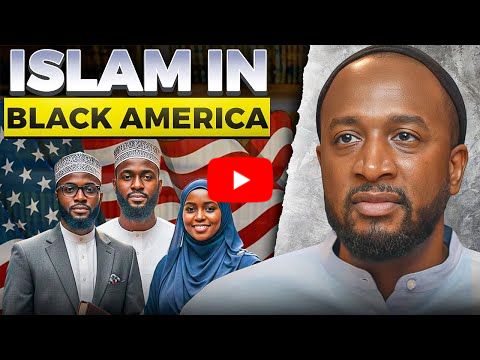
What Is the Message of Al-Islam to the African-American People?
A fair question—maybe the central question—is this:
What is the message of Al-Islam to the African-American people?
And I want to say this carefully, because the question itself can be misunderstood. This is not an argument for a “Black Islam,” as if Islam is segmented into racial versions. There is only Al-Islam—the universal guidance of Allah for mankind. The real question is different:
How does the universal message address the particular wounds of a particular people?
How does it enter a specific historical condition—like the African-American condition—and offer solutions that actually heal?
I believe something important follows from this. Until we learn to communicate Islam in a way that clearly conveys its relevance to our needs as a group, we will not fully see its value as what the Qur’an calls it: a light and a mercy. Not because Islam is incomplete, but because our presentation will remain incomplete.
We Don’t Need “Theology.” We Need the Sciences of the Book.
Let us begin with a preliminary discussion—something foundational that builds the road for where we’re going in this series of essays. One of the first things we have to clarify is the language we use.
In Western tradition, people say “theology,” meaning “the study of G-d.” But that is not a Qur’anic framing. We do not “study G-d” as an object. What we are given in the Qur’an is something else: revelation to be recited, purification to be undergone, and guidance to be learned.
The Qur’an describes the prophetic mission as: reciting the signs, purifying the people, and teaching them the Book and wisdom.(62:2)
So the question becomes: does the Qur’an give us a science—a structured way of understanding reality—and does it give us a wisdom—a logic for how human life should be ordered?
If we can answer that, then we can ask a deeper, urgent question:
Does the Qur’an provide a framework for analyzing a people placed under conditions like ours?
Does it give us case-studies—patterns—laws of social life—by which we can understand oppression, recovery, and renewal?
And the answer is yes.
From Darkness to Light: The Qur’anic Signature of Oppression
Allah describes the Prophet ﷺ and the Qur’an with a clear purpose:
A Book revealed to bring mankind from darkness into light. (14:1)
That description is not only spiritual. It is also social. It is civilizational, because that same language—darkness to light—appears in the story of Musa عليه السلام, when Allah commands him to bring the Children of Israel out of their condition under Pharaoh.
Here is what is important: the Qur’an does not always describe oppression by listing every detail of abuse, every brick, every chain, every policy. Often, it gives something more powerful: a general description of a condition. The Children of Israel were in darkness, and that forces us to ask: what does the Qur’an mean by darkness in the life of a people?
To answer that, we must look at how the Qur’an explains Pharaoh’s oppression. Allah says, “They slaughtered your sons and allowed your women to live.” (28:4) This phrase is not merely a historical detail. It is a strategy. It is a pattern. It is a blueprint of how a people is broken, a systematic destruction of a people’s future.
“Slaughtering the Sons” Means Killing Leadership Potential
Why does the Qur’an highlight sons? Because a boy is a man in potential. A male child is not merely a body—he is a future carrier of responsibility. He is the seed of leadership. He is the future builder of families, protector of homes, and producer of the resources by which community life is sustained.
The Qur’an teaches that mature men are charged with maintenance and protection—meaning that in the structure of family and society, men carry the weight of provision, defense, and public responsibility. Not because women are less, but because roles in creation are not the same, and society collapses when these roles are denied their sacredness.
So when Pharaoh “slaughters the sons,” the meaning is bigger than physical murder. It is the killing of leadership before it can rise. It is the destruction of the ability to develop men into responsible providers, the capacity to produce independent direction, and the possibility of self-governance and self-protection. A people without developed men becomes a people without leadership, and a people without leadership becomes easy to dominate—because direction no longer comes from within.
And yet, Pharaoh “allowed the women to live.” Why? Because women carry the home. Women carry the children. Women preserve the human life of the community. But if women are left to survive while men are destroyed, the community is held in a painful contradiction: their needs remain alive, but their leadership is killed. So now the group still exists, still hungers, still requires provision, still needs stability—yet must depend on the very system that crippled it. This is not just oppression; it is the manufacturing of dependency.
Oppression Is Worse Than Slaughter
The Qur’an gives us another lens on this. It teaches that oppression—fitnah–is worse than killing. Why? Because killing ends life once. Oppression kills slowly—over time. It damages the soul, the intellect, the family structure, the moral confidence, and the psychological stability of a people. And once that damage spreads, it produces ripple effects across generations. This is why we can’t analyze our community only through blame. We need analysis. We need science. We need wisdom. For instance, many men in our community’s history and presently have mistreated their wives verbally and physically. However, a man doesn’t wake up one day abusive without reason, without there being any causes or conditions that put him in that abject state to begin with. Now, to be clear, the causes behind his behavior don’t excuse abuse—but it is necessary to know them if we are to effectively address the issue. When frustration is bottled, when dignity is denied, when manhood is blocked from healthy expression, that pressure often finds the easiest target: those closest to you—wives, children, siblings, even the self through addiction. That is part of what oppression does: it turns a people inward against itself. It converts external violence into internal collapse.
Liberation Is Not Only Physical
And here is one of the most sobering lessons from the Qur’anic story of Musa: even after the Children of Israel were physically freed, traces of the old bondage remained inside them. They crossed the sea—and immediately wanted new idols(7:138). They became restless and demanded the tastes of Egypt (2:61). Thus, they carried with them the spiritual sicknesses they gained while in Egypt and remained influenced by them psychologically even after being liberated physically.
This tells us something critical: though a people can be free in one sense, they can persist in bondage in another. In Islamic language, this is why liberation is not only “exodus.” It is also hijrah—leaving what Allah forbids, migrating away from the internal world of corruption and into the world of truth. So when the Qur’an says “from darkness to light,” it is not only talking about changing a location. It is talking about changing a condition of mind, a condition of behavior, a condition of soul, and a condition of society.
Why This Matters for the African-American Question
All of this brings us back to where we started: What is the message of Al-Islam to African-American people? Part of the answer is this: Islam does not only condemn oppression as an external enemy. Islam exposes oppression as a system that:
-
destroys leadership potential,
-
manufactures dependency,
-
reshapes psychology,
-
fractures families, and
-
produces generational after-effects even after formal freedom.
And that is why the Qur’an is relevant. Not because it flatters us. Not because it offers slogans. But because it offers a diagnostic framework—an honest map of how people rise, how people fall, how people are trapped, and how people are truly restored.
Addressing these points will be our focus in future essays. Among the many themes we will cover, and questions we will attempt to answer are:
-
What exactly is “darkness” in Qur’anic terms?
-
What does “light” look like socially, not only spiritually?
-
How does Islam rebuild men without degrading women?
-
How does it rebuild women without erasing the sacredness of family?
-
How does it produce internal leadership again?
-
How does it break dependency without producing bitterness?
-
How does it give people a future without making them prisoners of the past?
This is not about inventing a “Black Islam.” This is about learning how to present Islam as what Allah sent it as–guidance that enters real history, heals real wounds, and rebuilds real societies.



Responses